
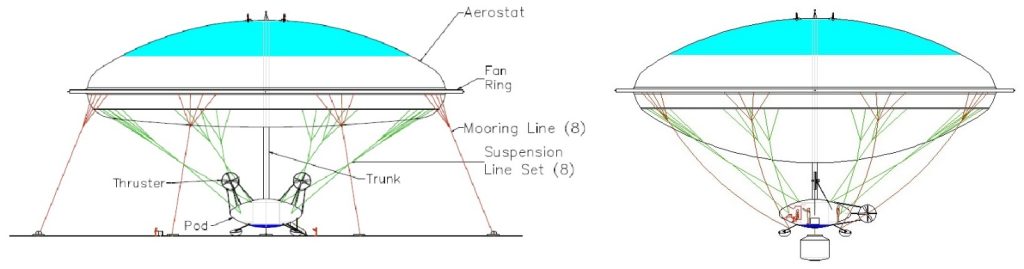
The above LS-L50D concept design with a Ø50m variable geometry lenticular aerostat was drawn 2014 as an omni-directional (OD) air-lugger for useful ad-hoc aerial-crane and transport duties with up to 5 tonne (5000 kg) payloads operating in a similar way to helicopters (but quietly with much longer range/endurance), intended to operate mainly within existing Commuter category certification rules (limiting development costs). Naturally, this would need CAA agreement.
At ground level, it’s similar in elevation (viewed from the side) to an SKS500 airship’s profile but, when moored, only occupies 25% of the ground area needed (due to fixation). In addition, it’s aerostat has a displacement volume of 20,400 m3 compared to the SKS500’s 5,130 m3, so gets near 4 times the buoyancy, one of the reasons it will lift so much more. With pseudo VTOL ability it also makes possible access into/out of small places for pick&put duties, not easy for SKS500 airships to do.
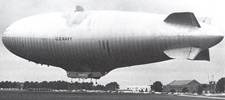
Now, the SKS500 series was developed in the early 1980s and certified under UK CAA BCAR rules. Today, it would be compliant under EASA Normal Category rules, limiting payload weight to near 900 kg (say 1 tonne), equating to about 9 passengers plus baggage. Even so, bigger non-rigid types under BCAR rules were allowed up to a max inflated envelope volume of 42,450 m3. This was based on the biggest non-rigid airship built and put into late 1950s service (the US ZPG-3W with 42,229 kg take-off weight). Even so, EASA Commuter Category rules limit payload weight to near 2 tonne. This equates similarly to about 19 passengers, needing only near 8,000 m3 displacement. It thus needs further consideration.
The Pod and its Payload
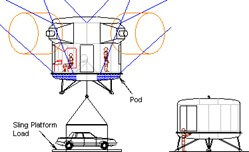
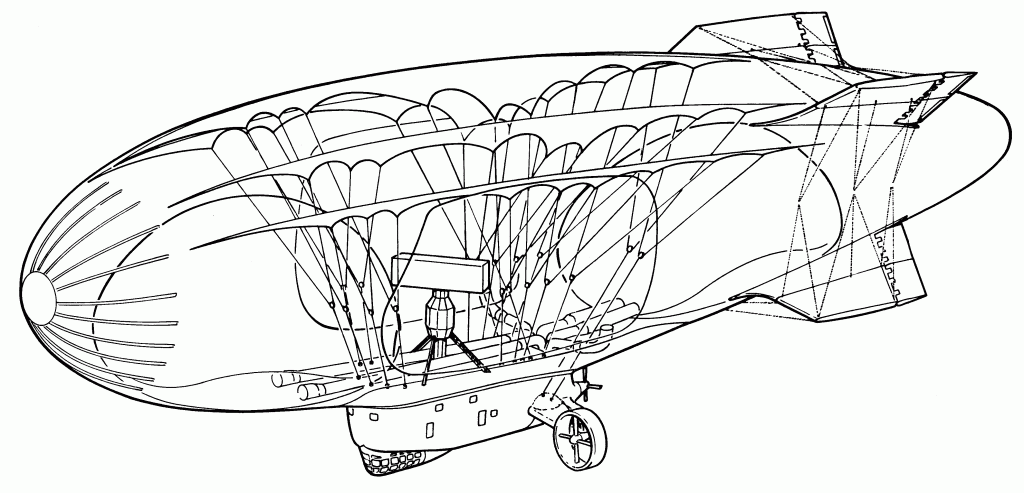
The LS-L50D pod (the main module for crew, systems and equipment – no passengers) is suspended from the aerostat by an external method. This spreads load more evenly and simply than is possible for traditional airships with close coupled gondolas. It also is good for operations without danger of breaking their aerostat’s back, a difficult problem to solve for UD airships like the US Navy’s YEZ-2A design. The payload (passengers, freight or single items) then is carried as an underslung load using pallets, modules or nets from a crane line system. This allows point-to-point payload pick-up, transport and put-down (pick&put) duties anywhere while remaining in controlled flight in a similar way to helicopters.
The LS-L50D arrangement was configured with 8 cycloidal propellers, 4 around the aerostat and 4 around the pod, all able to direct thrust horizontally or vertically (up or down), designed to overcome significant differences between weight and buoyancy, and to control flight. This is notional until test flights at full scale are undertaken to properly assess configuration matters and operating needs for the type, which is being determined from smaller variants. The pod also has underfloor ballast tanks sufficient for load exchange, although LSL is working to reduce the need.
Benefits of the design are endurance and ability to scale-up for considerably more lift (factors > 10), not possible for helicopters. Costs and time to develop the design should be less than an equivalent helicopter. For further information, see its leaflet.
Considerations for Development
The LS-L50D currently isn’t scheduled for development as it needs a number of key technology and ground infrastructure aspects to be worked out first (e.g., cycloidal propellers, power and control). It also needs people trained and ready for operating duties, enabled by smaller types. Sizing also may change because of airworthiness acceptance limits for Commuter Category aircraft.
This is a sticking point because the authorities set limits based on non-BA types, which don’t use an aerostat but do use dangerously high airspeed to fly in the first instance (where take-off and landings are critical phases). Reaction time to safely deal with failures and incidents (such as bird strikes) at high speed then is short, where they may rapidly fall and crash with catastrophic results. Ability to float in the atmosphere with zero to slow airspeed, enabled by aerostats, changes these circumstances, reducing the likelihood of catastrophic incidents.
Even so, to meet current imposed limits on Commuter Categary aircraft weight, a smaller LS-L40D type was designed 2021, as shown below. This has a similar but Ø40m aerostat configured with screw propellers to overcome the shortfall of suitable cyclorotors. It also has improved performance for payloads with further methods to enable rapid pick&put duties without load-exchange (i.e., the process to maintain balance between overall aircraft weight and aerostatic lift (buoyancy).
The LS-L40D’s aerostat has 12,270 m3 max geometric volume, so more than twice the capacity of an SKS500 series airship. However, its LTA gas-fill under standard conditions will be somewhat less to accommodate expansion up to 3,000m altitudes, also depending on climate conditions. It’s capacity is a little greater than the 75m long Zeppelin LZ N07-101 airship, which sweeps a circle of Ø150m at its mast that must be kept clear of obstacles.
Nonetheless, LSL believes the authorities should increase its limit for similar Commuter Category Luffships to vertically-lift/transport 5 tonne or greater underslung payloads point-to-point over 2000 km or more, where they mainly would be used over sparsely populated regions for cargo transport and patrol duties. Some helicopters can fulfil the vertical lift need at the moment, so there is a way to fulfil relatively low-weight aerial-crane needs; but not also over 2000 km. This is because helicopters are limited by physics, which BA overcome.
The fact that there aren’t any BA able for such duties while there are people paying for gas guzzling limited range/endurance/payload helicopter aerial-crane services is evidence of market need for better ways, and where aerial-cranes for heavier payloads (say for wind-turbines) are left wanting.
We are interested to hear from people with real needs for serious aerial-cranes to register their interest and begin the dialogue to see how LSL’s Strategy for such buoyancy assisted OD types may be fulfilled in quicker, cheaper ways.
It’s time for a new way to go, which Luffships provide. After all, our team successfully led the technical effort for a BA that did vertically air lift and was used over a 2 km course to carry a tank weighing c50 tonne. By comparison, 5 tonne is just a walk in the park. Please go to contact to register interest.